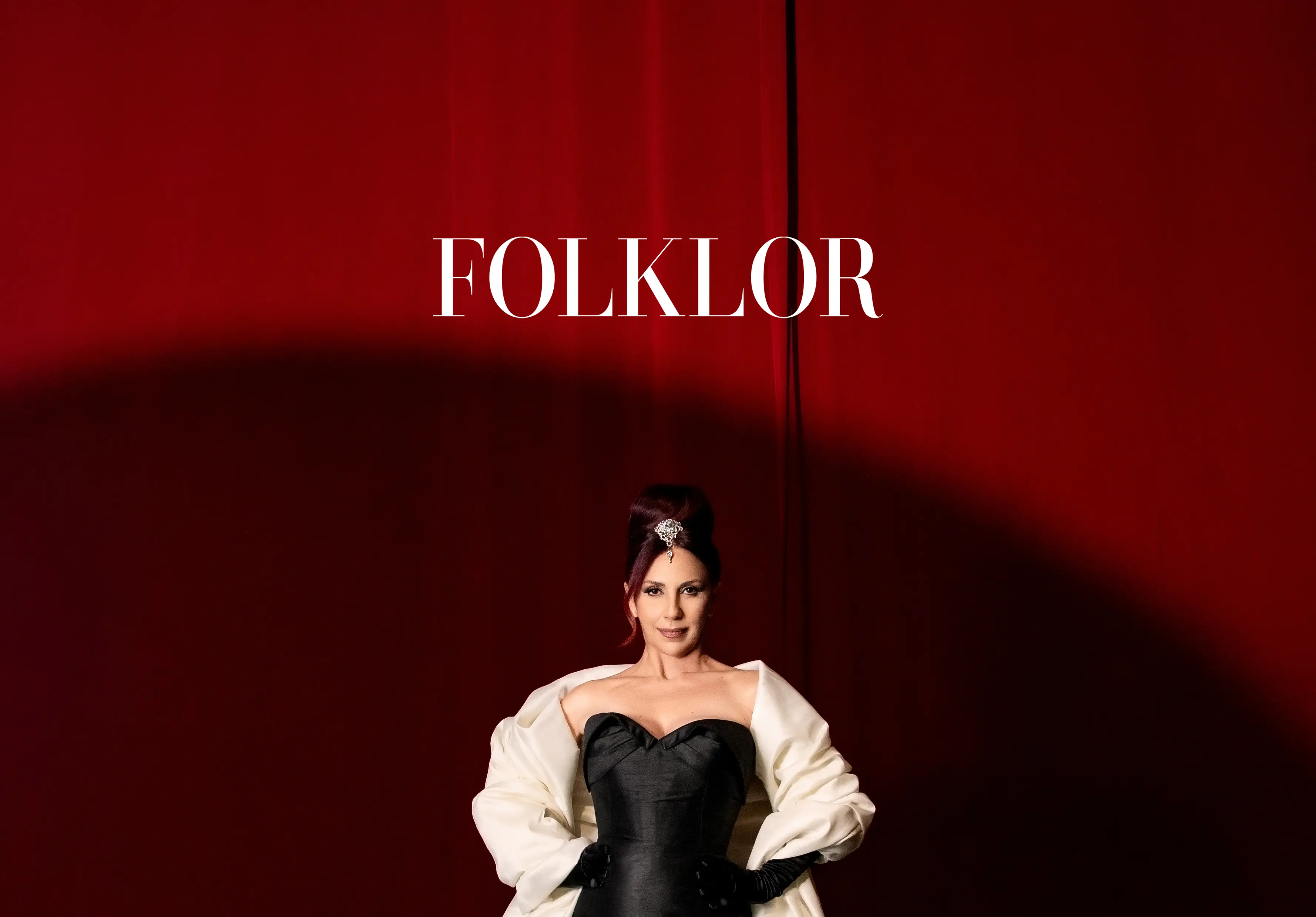
For a magazine dedicated to legacy and what truly endures, FOLKLOR pays its ultimate homage to an artist who not only defined an era but elevated an entire art form. In the vibrant, post-war renaissance of the 1990s, when Lebanese culture soared, Amani emerged as the undisputed Empress of Oriental Dance, redefining Raqs Al Sharqi from commercial spectacle into a sophisticated vehicle for stage productions and theatrical performances of caliber.
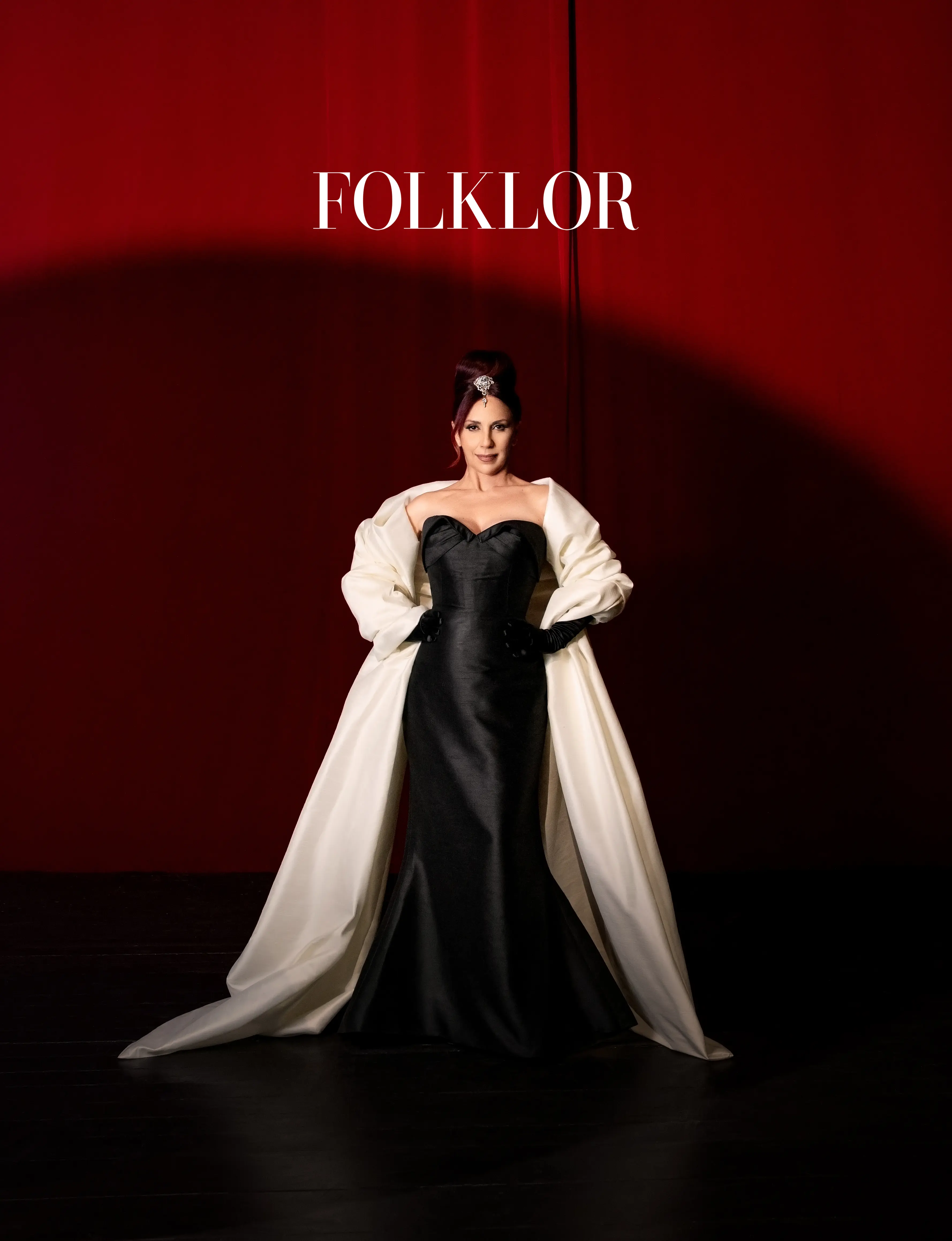
This cover story introduces Amani as "The Last Diva," a title that acknowledges her singular, commanding presence and eternal influence. To capture the depth of her legacy, FOLKLOR filmed a cinematic tribute: Amani, decked in immaculate couture, takes a solitary, nostalgic trip to the historic Al Madina Theatre in Beirut. The theatre is empty, and on the grand velvet curtains, a projection begins; her groundbreaking 1992 video clip, the first of its kind for an Oriental dancer.
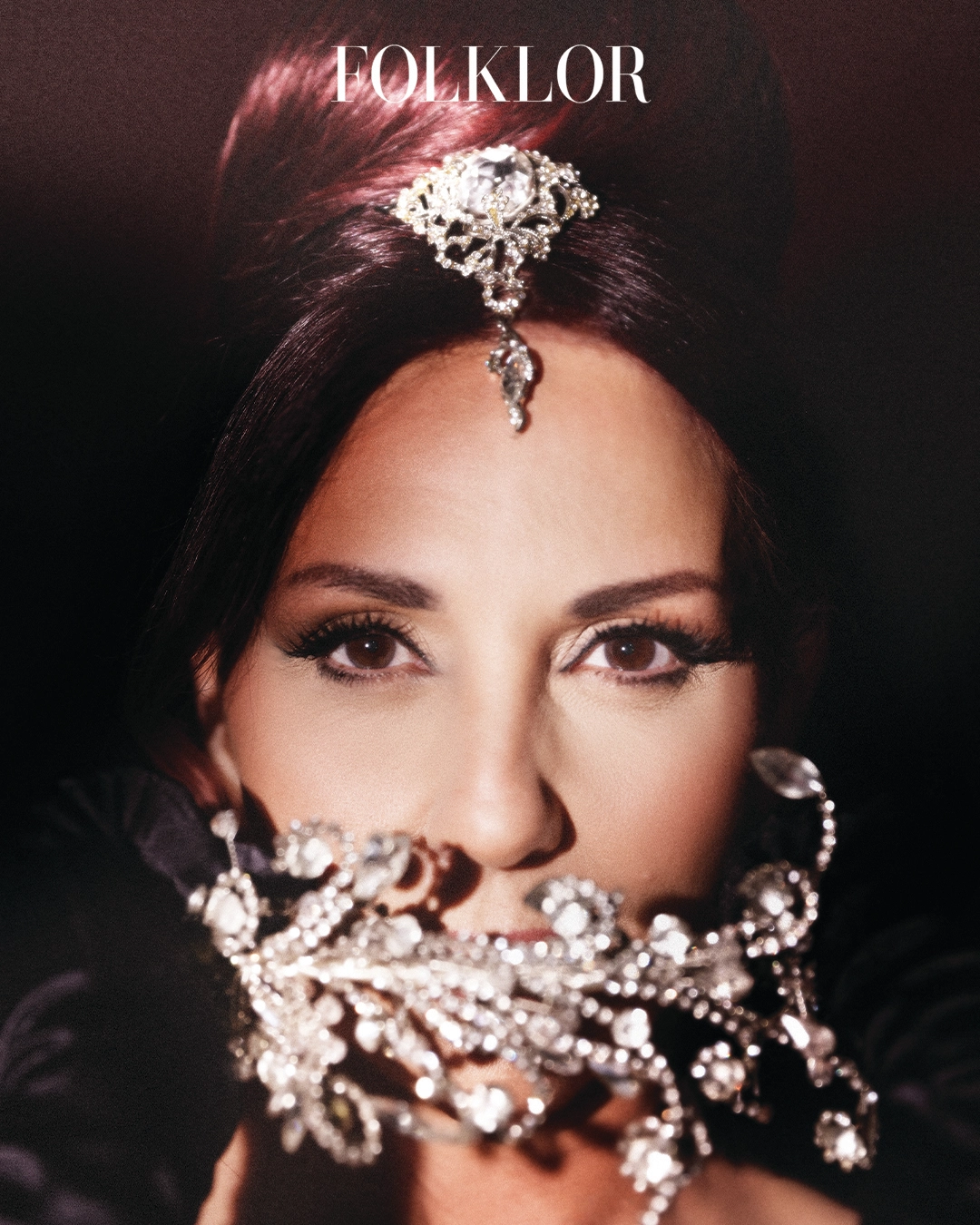
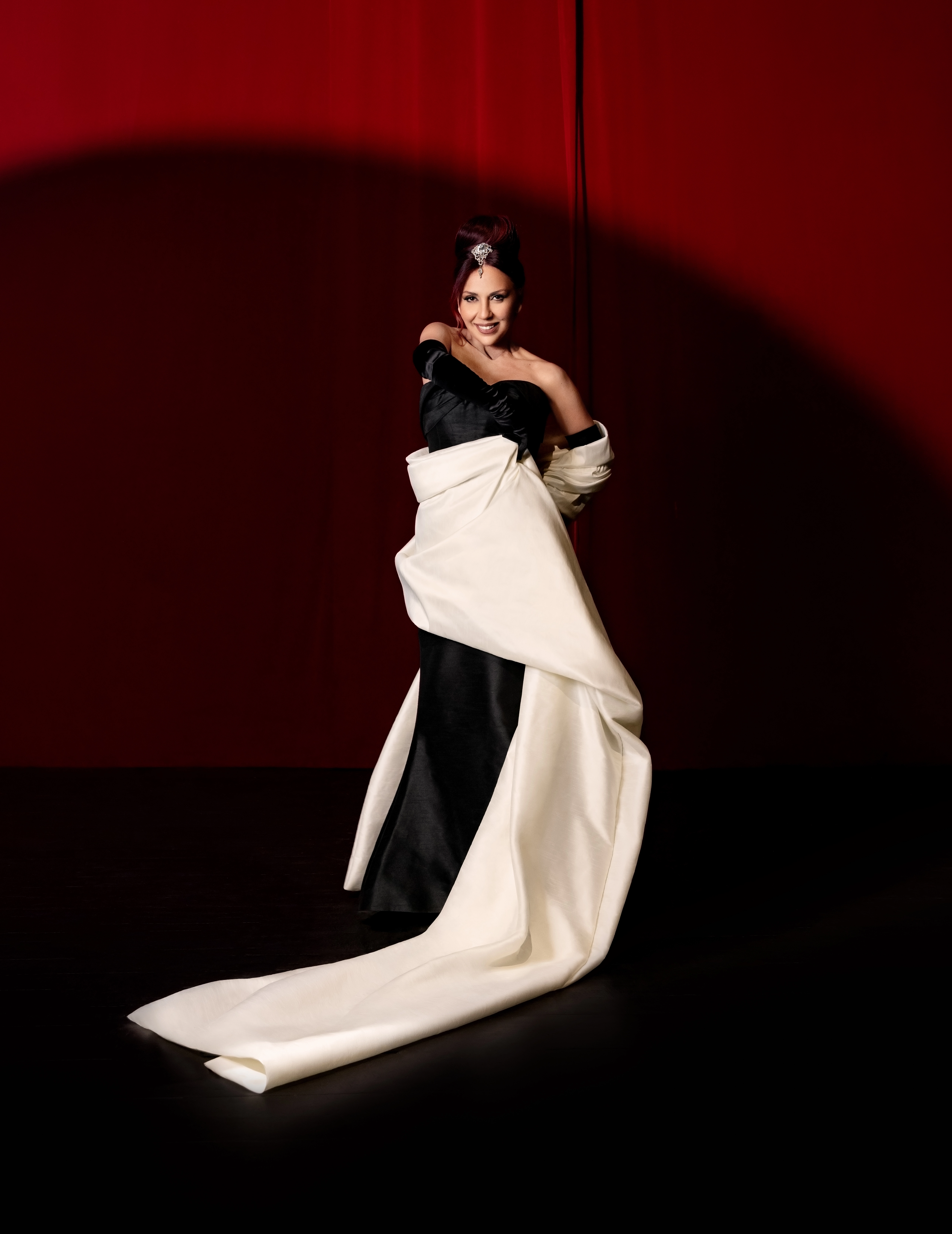
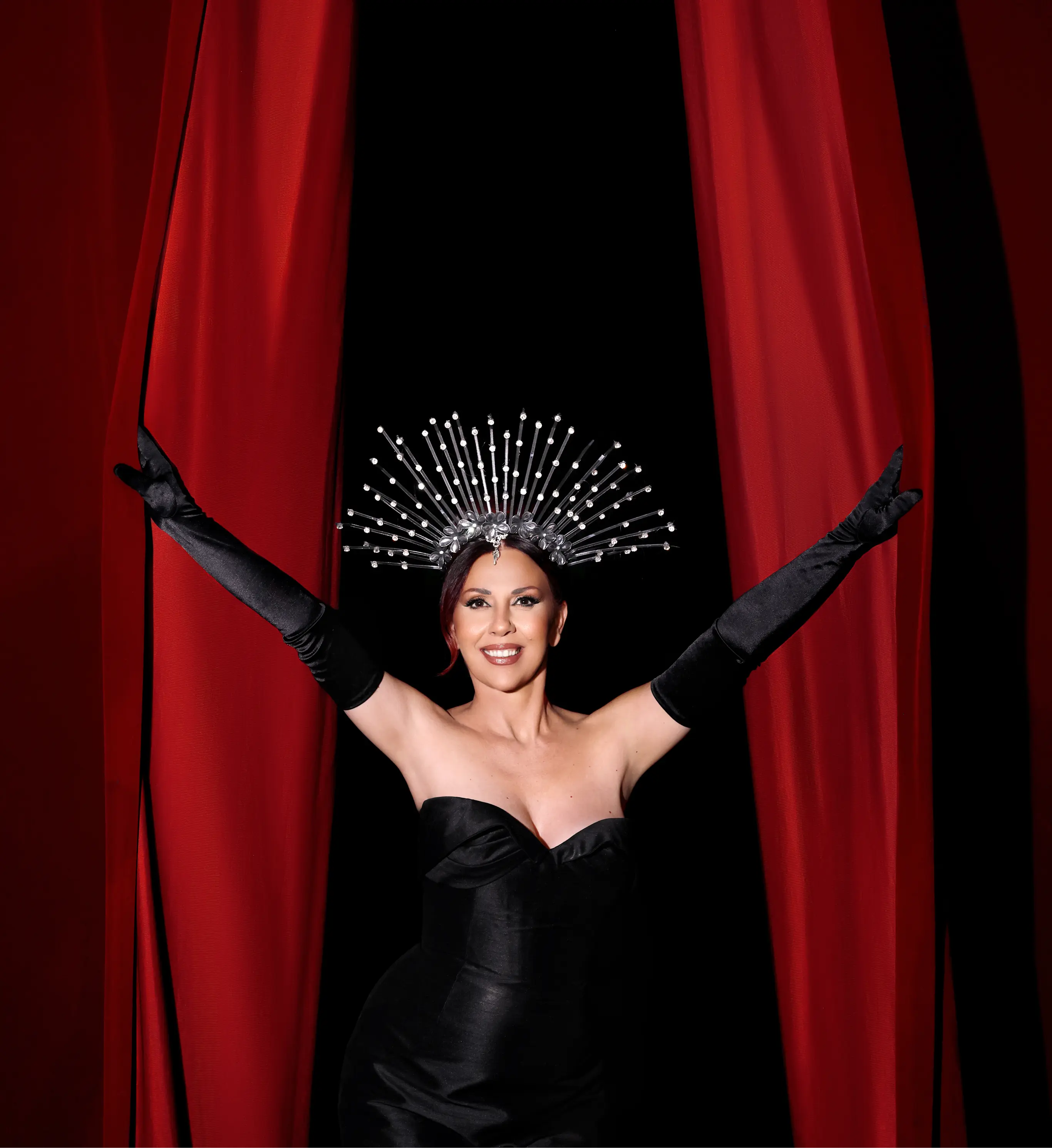
As the frames of her past dance across the colossal stage, Amani watches her younger self, bridging two golden eras. Then, in a final, powerful moment for our exclusive shoot, Amani emerges like a vision from behind those same curtains, revealing the complete and eternal woman she is. She is a breathtaking icon, glistening like a diamond etched forever in the history of Lebanese and Oriental dance.
Your visit to the Madina Theatre to view the projection of your 1992 clip is incredibly moving. What does that specific clip; an innovation that defined a new era of Oriental dance video represent to you now? Does seeing your 90s self in that space change how you view Beirut's cultural peak during that time?
“Of course, when I watch this music video again, it doesn’t only bring back memories of a beautiful artistic era in the country, but it also reminds me of the passion and spirit of adventure that pushed me to present anything new I truly believed in.
For example, this music video itself was a real adventure. At the time, there was no precedent for such an experience, no guarantees of success. I didn’t know whether it would become a trend or resonate with people, but I had an inner conviction that it could touch them as something new and different.
If you ask me today about how I look back at the 1990s, I wouldn’t say it was a beautiful period merely because “old is gold.” It was beautiful because people were more connected to our values, our ethics, our heritage, and our shared concepts. There was more respect and affection between people. Life felt simpler, deeper, and more meaningful—not only culturally and artistically, but in every aspect.
Of course, my perspective has changed over the years. With time, experience, and work, a person evolves and matures. People have changed too; their culture, their concepts, and their perception of art. In the 1990s, art was largely shaped by true creators who produced beautiful, original works with genuine creativity.
Today, anyone can be called an artist, a global figure, a maestro, or a creative mind; even if they lack the most basic artistic foundations. Unfortunately, the world tends to celebrate them anyway. People have become lost between truth and illusion, between the original and the fake. And the real fear is that tomorrow, the lie might become the truth.”
The 1990s in Beirut is often described as a second "golden age" for Oriental dance. What elements social, political, or creative converged to make that decade such a fertile ground for this art form? How did the post-war atmosphere influence the audience's appetite for glamour and theatricality?
“In the 1990s, especially in the immediate post-war years, there was a profound hunger among people for art, for joy, for culture, for beauty. And what made that decade so fertile was that the spirit of the earlier golden eras the 50s, 60s and 70s was still alive. The war hadn’t destroyed our artistic DNA. The cultural values, refinement, and authenticity of previous generations were still deeply rooted in both audiences and creators. Another crucial factor was that many of the figures who shaped Lebanon’s ‘first’ golden age were still present and active. They remained influential voices on the artistic and cultural scene, and their presence helped guide and elevate the emerging post-war landscape. And then there was structure. There wasn’t the chaos we see today no media anarchy, no limitless social platforms. There was cultural regulation, which, despite its limits, helped protect the art form from vulgarity and dilution. Even when something questionable slipped through, society rejected it. People’s internal compass their upbringing, their sense of taste naturally filtered out anything cheap or inauthentic. All of this, combined with the collective longing for beauty after years of conflict, created the perfect atmosphere for Oriental dance to flourish once again. It allowed the 90s to become a second golden age, rich in creativity, theatricality, and artistic depth.”
In 1992 You introduced the concept of the Oriental dance "video clip," setting a major trend that was widely copied. What was the critical thought process behind transforming a traditional stage performance into a cinematic piece of media, and did you realize at the time you were creating a new commercial and artistic blueprint for the industry?
“In 1992, when I created the first Oriental dance video clip, I was truly going against the current. It was not an easy path. I faced resistance and many practical challenges, but I was determined and I thank God I managed to achieve much of what I dreamed of.
At that time, the music video format was the biggest trend of the 90s, but no one had yet imagined an Oriental dance video clip. The idea simply didn’t exist. So when I experimented with it, I wasn’t thinking of creating a blueprint for anyone; I just wanted to offer people something joyful and fresh. The video clip allowed me to present dance in a completely new language: fast-paced, expressive, cinematic, rich in costume, beauty, and imagery rooted in folklore and culture. Sometimes it was pure dance; other times it was visual storytelling without choreography at all. The format opened creative doors I couldn’t access on a stage.
Later, that same medium allowed me to create pieces with real narrative depth, like ‘Nefertiti,’ where I told her story, her struggles, and the truth of her journey through movement and imagery.
Did I know it would become a trend? Did I anticipate that others would copy it or that it would reshape the industry? Not at all. I never imagined it. I had performed these works on stage, but the video clip allowed me to communicate them to the audience in a completely different, cinematic, and more expansive way. That was the true breakthrough.”
The 90s marked a profound renaissance for Raqs Al Sharqi in Beirut, often described as a second golden age. In your view, what specific contributions stylistic, theatrical, or cultural did your distinguished predecessors from the 60s and 70s, such as Nadia Gamal, and Kawakeb, establish that were essential for the art form to reach its subsequent peak in the 90s?
“Every true creator leaves an imprint. Whatever a pioneer contributes stylistically or culturally becomes part of the language inherited by the generations that follow. This is the essence of artistic legacy: those who have no past cannot shape a future. Just as we learned from those before us, they too had inherited from others, forming an unbroken chain.
Oriental dance never had ‘formal schools’ in the earlier decades. What existed instead was transmission and heritage passed from grandmother to mother to daughter, from artist to artist. This is the true folklore, the living legacy that reached us today.
And within that lineage, the ones who genuinely innovate are always very few true creators you can count on the fingers of one hand. Thousands of performers may appear over the years, but inauthentic contributions disappear with time. What endures are the names of those who were original, refined, and sincere.
The great dancers of the 60s and 70s Nadia Gamal, Kawakeb, and others belonged to that rare group. Their artistic intelligence, their refinement, and their ability to merge heritage with innovation created the foundation on which the 90s renaissance was built. Without their legacy, the second golden age could not have reached its peak.”
5. You championed the elevation of Oriental dance into a respected art form, rejecting the term "Belly Dance." Where did this mission to restore the art's dignity and historical depth originate, and what impact do you see your battle for correct terminology having on the profession's image?
"I always had a vision of Oriental dance that was very different from the common image people know. And I have always tried to present that deeper vision.
What matters most is that Oriental dance is not what the Western term ‘belly dance’ suggests. That term represents only a small, distorted fragment of the art, a narrow, superficial image; while the true world of Oriental dance is vast and much richer.
My struggle, however, is not only with the term “belly dance”- a very ugly and degrading name that cheapens the art. My struggle is also with the image that accompanies it, an image that is getting worse every day, becoming the umbrella under which the public understands the dance.
Unfortunately, this distorted image is most widespread in the very countries where Oriental dance originated. Meanwhile, abroad; especially in Western countries, many foreign dancers are deeply committed to presenting the dance with beauty, refinement, and respect. I met many of them in festivals and through social media, and they, like me, reject both the cheap image and the offensive name. Yet for some reason, people persist in using that terrible term; I truly don’t know why.
The true dancer, the true artist is the one who can captivate an audience for half an hour, an hour, or even two hours through artistry alone, without resorting to erotic gestures or revealing her body.
This is precisely why I created my first show Histoire ; a French word that means both history and story. In that show, I was either narrating the history of the dance or telling a story through the dance. It may have been the first time in the history of Oriental dance that narrative structure real storytelling was introduced.
My shows evolved, year after year; until I finally felt that I had achieved the artistic vision of moving Oriental dance from the confines of night clubs to theatre in the year 1996 and later imbuing it with a new cultural identity and aspect with a grander theatrical scale".
If we title this feature "The Last Diva," what does that term mean to you? Do you see a gap in the current landscape for a figure with that kind of singular, commanding presence, and what advice would you give to today's dancers who are navigating a fragmented social media-driven landscape?
“First, I want to thank you for the generosity of calling this feature ‘The Last Diva.’ I understand what you’re trying to express with that title, especially in light of the chaos we see on the dance scene today.
I always try to view things positively. Life is fertile; it produces. But chaos is destructive. Where there is disorder, art cannot grow.
Still, I believe there are good seeds out there; young artists with sincerity and potential. What they need is fertile ground.
My advice to today’s dancers is this: Do not be swept away by the noise, the trends, or the speed of social media. Focus on creating respectable artistic work that is dignified and removed from vulgarity. Because time has proven one truth: only what is authentic survives.
We remember the greats; the truly original, the refined, the sincere. Meanwhile, hundreds and thousands of names have vanished without a trace.
If a dancer wants her name to endure, to be spoken with respect, she must work with honesty, discipline, and artistic integrity. That is the only path to becoming more than a trend; and perhaps, one day, a diva whose legacy lasts.”
Today, there is widespread debate about the origins of Oriental dance. Some insist it is exclusively Egyptian, citing imagery and rituals from ancient Egypt, while others point to similar celebratory movements found in other civilizations such as India, the Levant, and even among the Phoenicians. From your perspective and with your ability to read the art form through authenticity rather than the noise of social media do you believe Oriental dance has a single birthplace, or is it the result of shared cultural expressions that evolved across multiple ancient societies?
“As for Oriental dance, it is the dance of a people the dance of a civilization not the dance of a single nation. Its origins are in the East, where it began as a dance of womanhood, rooted in human nature itself, long before anything called ‘states’ existed or countries were established.
And if we want to speak historically: when were these states even founded? When we look at Ishtar and Mesopotamia ; civilizations that existed a thousand years before ancient Egypt and the Nile Valley; there were already rituals and dances tied to femininity, fertility, and worship. Damascus, for example, is the oldest continuously inhabited capital in the world, over seven thousand years old. All of this predates what we call “national dance identities.”
We must be conscious and free from emotional bias when we talk about history. We need to be rational, and to truly love our work rather than getting carried away with claims of ‘legacy’ and exaggerated narratives. The truth is bigger and older than all of us.”
Your entire career is a testament to the idea that culture and legacy endure longer than any trend. How important is it to you that magazines like FOLKLOR consciously dedicate space to documenting and validating the history of Lebanese arts and fashion, ensuring it doesn't "fade away," as many of figures in the Arts fear?
“Everything even the way people once loved and respected one another; comes from our heritage, from our manners, from our values. Folklore is not decoration; it is belonging. It is identity. And today, more than ever, we must protect that identity and our collective sense of belonging as one people.
Globalization threatens to erase not only the identity of our ancestors, but also that of future generations. That is why platforms like FOLKLOR are essential. Documenting, validating, and honoring our artistic and cultural history is not a luxury but a form of preservation.
So I truly encourage your work and wish you all the success. What you are doing is deeply needed, and I hope the path ahead opens for you in the way you deserve.”



.webp)
.jpeg)
.webp)